 Great Dane
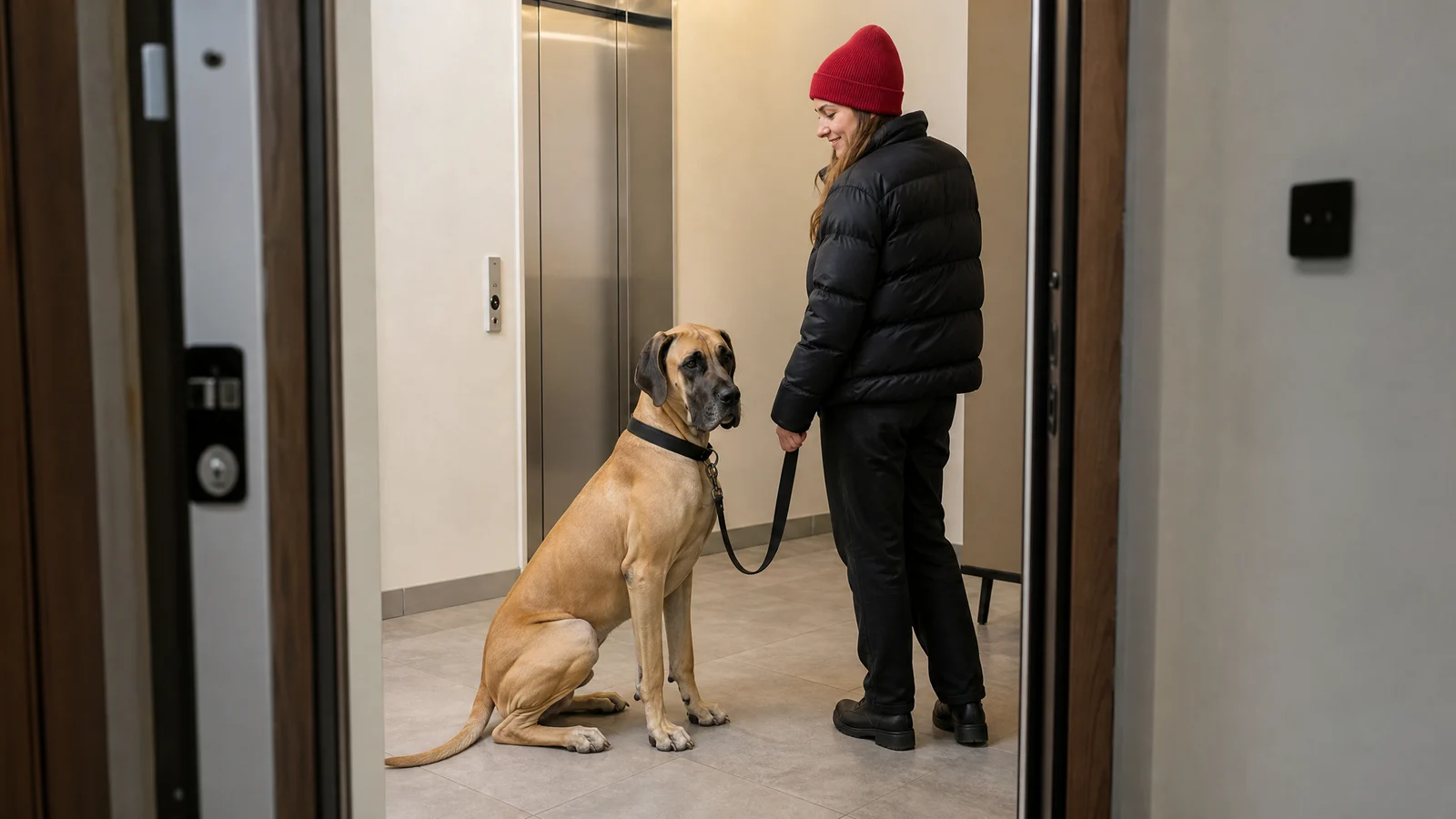
The usual advice says a dog this big needs a big yard and hours of hard exercise, which makes an apartment look like a poor fit for a Great Dane. Owners who live with them in small homes report something different: a dog who mostly wants to lounge near a person, following them from room to room and settling within a couple of feet of the family.
That calm does not arrive by itself, though. An XLarge dog with a busy mind and no manners becomes a bored housemate, a worry in the hallway and a standoff at every elevator. Taught well, the same dog becomes the quiet one neighbors wave at. We'll walk you through one example puppy's first weeks, then the settle mat, hallway and doorway skills, daily exercise and brain games, and the setbacks to expect.
Apartment Training Basics
Floor space matters less than you might expect, because an adult Dane mostly takes up room when moving. Males run 140–175 pounds and stand 30–32 inches at the shoulder, and females run 110–140 pounds and 28–30 inches. That bulk shows up at hallway turns, elevator doors and narrow kitchens, so calm manners count for more than square footage.
The ratings explain why this works. Danes earn a 4 out of 5 for energy level, and the same 4 out of 5 for how much their minds need to do, so both body and brain want a job. Yet the breed standard pictures a dog who would rather lounge on the couch near a loved one than do almost anything else. Both are true, and training is what connects them.
We have trained this breed for many years, and the pattern is consistent. A Dane who gets structured movement, some thinking work and a clear place to rest will settle beside you. One who gets none of those starts inventing entertainment, and with a dog this tall, the entertainment usually involves your counters.
Owners who share small homes with Danes tend to adapt the space in a few practical ways before any training starts:
- Cover the couch with washable blankets, hand the dog a spare room, or fit a bed or crate into the living area. Owners report all of these working in medium apartments, and the dog stays close either way.
- Put a waterproof mat and a towel under the water bowl. Owners describe splash zones, water running from the jowls and kibble dropping from the mouth, and a slow feeder fixes the food mess but not the water.
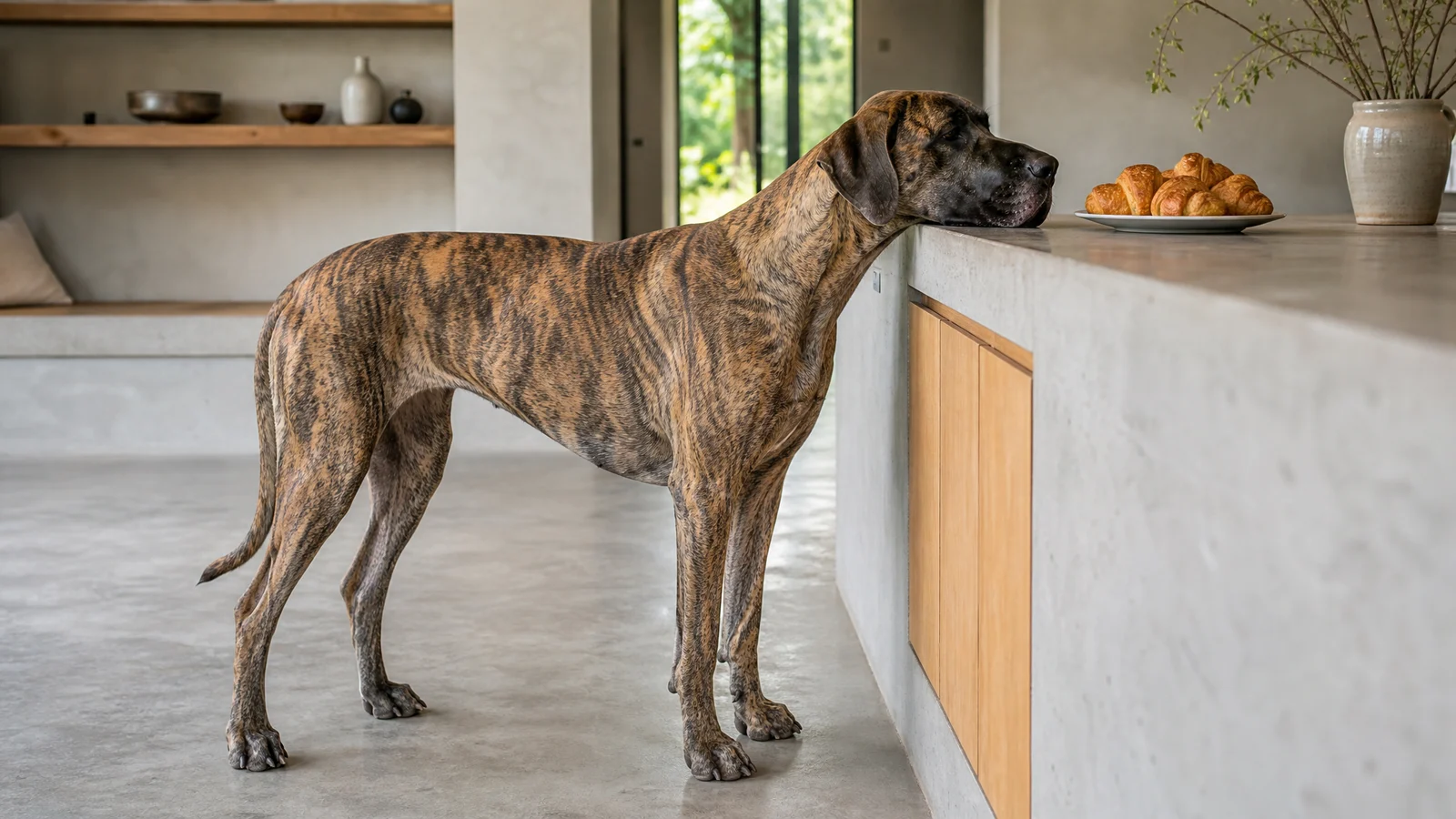
- Keep human food off the counter from the first day. Danes snatch bread, find the butter dish and slide open closet doors, so some owners add child locks. A dog who never gets a payoff rarely keeps trying.
- Reward only the cute behaviors you want to keep. Licking condensation off cups, or a paw that flies up when the dog is excited, can harden into habits you then have to manage.
Training a Ten-Week Great Dane Puppy
Everything from here on follows one typical setup, laid out so the steps are easy to picture. Our example is a newly arrived Great Dane puppy in an upper-floor apartment with two bedrooms. The front door opens onto a corridor, a neighbor's door sits directly across, and the elevator waits at the far end with a stairwell door beside it.
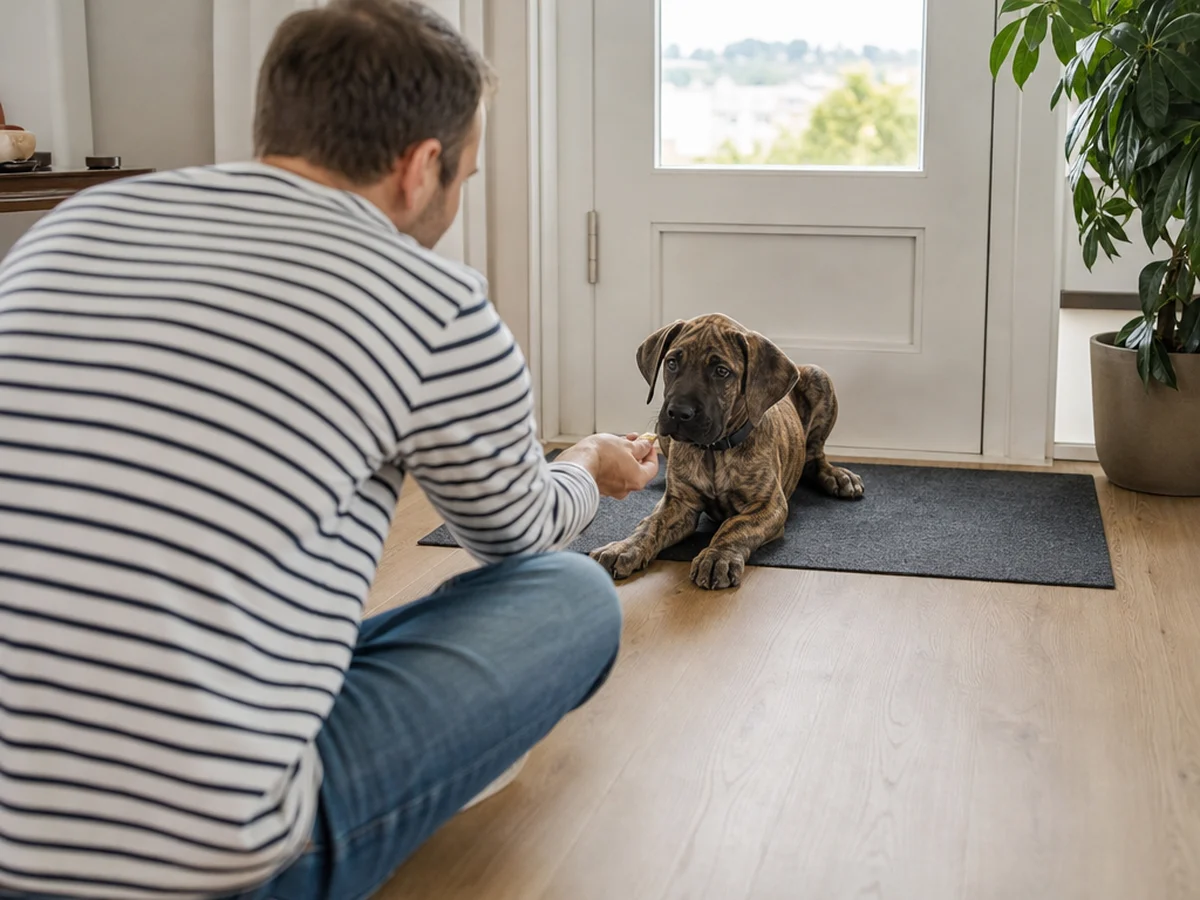
Inside, the living area holds a couch and a dining table, and the kitchen opens straight onto it. The second bedroom is an office. The puppy sleeps in the main bedroom at night and has a bed in the living area by day, which matches what many owners do with a night spot and a daytime resting spot.
The household schedule is ordinary. One adult works from home most days and the other leaves in the morning, so there are potty trips and a walk at the start of the day, a long quiet stretch at midday, and a busy evening of dinner and television. The puppy needs a plan for each of those blocks.
Plan for the dog this puppy becomes, not the one in your arms. Some owners report puppies who are already very heavy within a few months and outgrowing an extra-large crate, and young females who are far along in size by seven months. Beds, mats and travel setups get replaced faster than most people expect. Week one has modest goals:
- Pair a marker word with food. A marker word is a brief sound, like yes, that pinpoints the instant the puppy did the right thing, with a treat following right after. Repeat it with food until the puppy turns toward you whenever they hear it.
- Reward lying on the living-area bed while the family watches television, so calm near people pays from day one.
- Follow a steady potty schedule and reward every success outside, as our Great Dane potty schedule lays out.
- Handle paws, ears and collar with treats. Owners report that dogs not handled early may refuse paw touching later, which complicates nail trims.
- Watch the corridor from inside the open door while eating treats, so hallway sounds become good news.
Ask your vet when the puppy can start walking in shared areas, and keep regular checkups through every stage. A puppy kindergarten class fits the three-to-six-month window, and from week two the plan moves to the mat.
Mat Training for a Great Dane
Weeks two to six of our example belong to the settle mat, a dedicated spot where lying down and relaxing reliably earns rewards. It works like home base in a game of tag: a place the puppy can always return to, where nothing is asked and good things happen. Because Danes want to be within a couple of feet of their people, the mat succeeds best where the family actually spends time.
Choosing and Introducing the Mat
Pick a mat sized for the adult, with a non-slip underside for hard floors and a cover that washes easily. Owners favor washable or waterproof setups, and some use crib or child-size mattresses because they fit, cost little and launder well. Dogs who shred every bed they are given have done well with a cut-to-fit rubber exercise mat.
Introduce it at a calm moment, not when the puppy is wild. Toss a treat onto the mat, mark the step onto it, and repeat for a day or two until the puppy chooses to go there.
Rewarding Staying Put
Decide the final picture first: the puppy lying on the mat, relaxed, while you move around the room. Then teach it in small steps, marking and feeding each one in order:
- Mark and treat any glance at the mat, then each step toward it.
- Mark all paws on the mat and feed there, so staying is where the treats are.
- Mark the lie down, then the hip roll or long exhale that signals real relaxation.
- Add a release word, a cue such as free that tells the puppy staying is over, and say it every time before they leave.
- Stretch the time between treats a little at a time.
Keep your voice low and your movements slow, since quick movements and high-pitched squealing excite young dogs.
Building Duration Near the Family
By weeks four to six, move the mat to the places that matter. Start beside the couch, then the dining table, then the kitchen doorway, where it doubles as an out-of-the-kitchen boundary: the puppy earns treats on the mat while you cook, and the kitchen floor earns nothing. Stretch the time from a few breaths to a full television episode, and drop back whenever the puppy gets up.
Danes lean and sit on people, a habit that feels sweet at ten weeks and heavy later. Reward lying on the mat beside you, and the closeness has a place to land.
Training Hallway and Doorway Manners
Next come the shared spaces. A threshold is any edge you cross together, such as a door frame, an elevator gap or the top of a flight of stairs. The skill is simple: the puppy pauses at each threshold and goes through only after the release word. The mat already taught that word, so you are reusing a cue the puppy knows.
Passing Neighbors and Strangers
Danes are sociable and friendly, and the breed is described as self-confident with strangers. Add size, and a joyful greeting can alarm someone who did not expect a giant in the corridor. Stop a few steps early, ask for the pause, and feed while the neighbor passes, so people in the hallway become part of the scenery.
Ask neighbors to stay calm, and let greetings happen only on invitation with all paws on the floor. Noise matters in a building too. Heavy paws and a deep bark carry through walls, so put rugs where the puppy paces, keep the daytime bed away from the shared wall, and reward the quiet glance at you after a footstep in the hall.
Waiting at Doors and Elevators
Start at your own door with the leash on and treats ready. Ask for a pause, mark the moment the puppy holds still, feed low beside your leg, then release them through. An elevator uses the same idea in a smaller box, so practice when the building is quiet:
- Wait a little way back from the doors and reward calm standing.
- Let riders exit first, then release the puppy in.
- Place the puppy beside you with hips toward the wall and feed low by your knee.
- If the car is crowded or a neighbor looks uneasy, wait for the next one.
- At your floor, pause at the threshold again before the release.
Stairs get the same slow pace. Keep the puppy on the wall side where the step is widest, pause on landings for a treat, and use the elevator when you can. A fast-growing puppy's joints deserve gentle treatment, so ask your vet how much stair climbing suits each stage.
This is general information, not medical advice. Check with your veterinarian before any medicine or diet change.
Turning Corners on Leash
Blind corners are the riskiest spots in a building, because whatever waits there appears at nose height. Slow down before the turn, bring the puppy to your side with a treat, and look before you proceed. Danes do best with other dogs under supervision, so an early pause gives you time to pick another route.
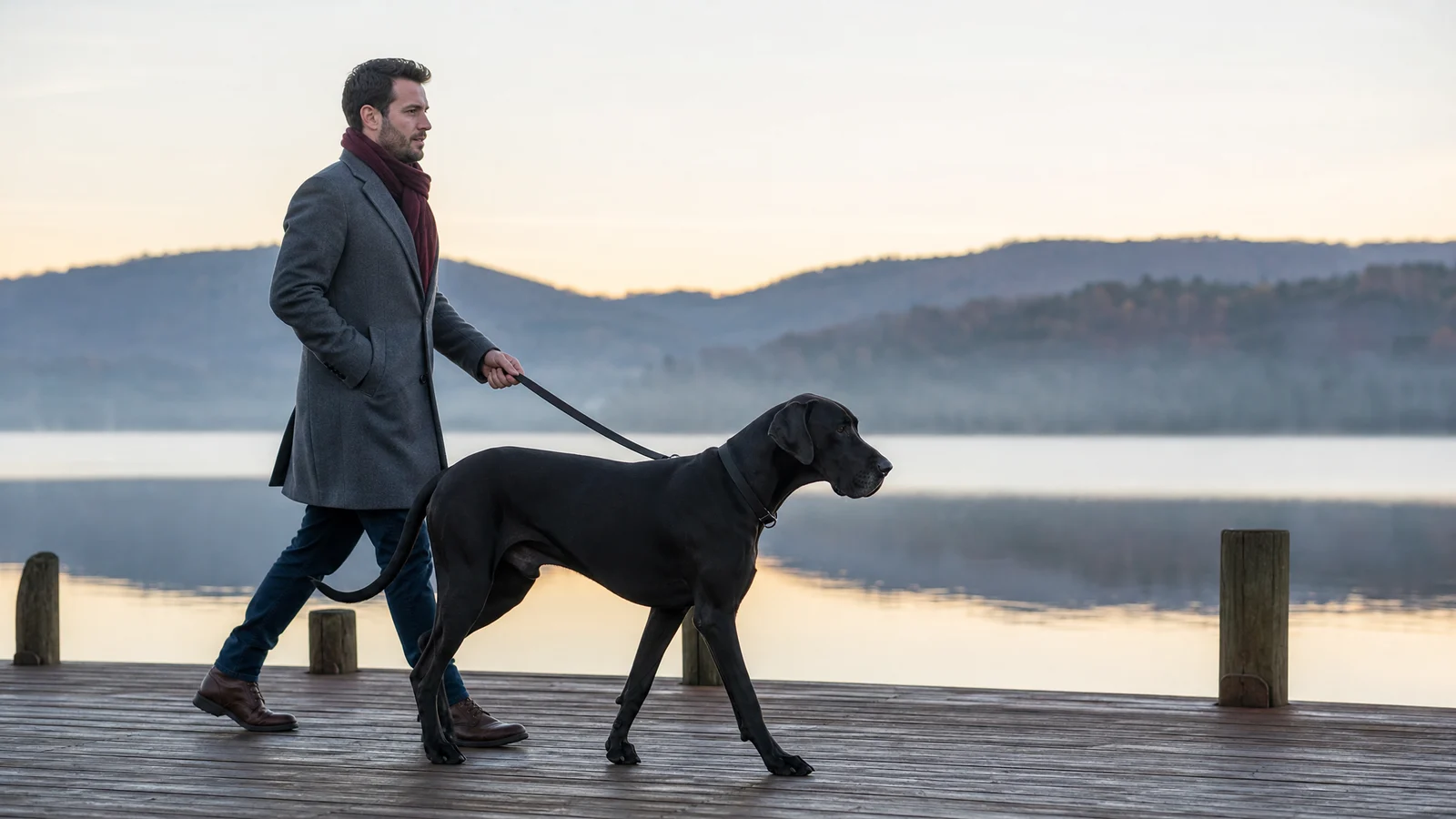
The leash itself should stay loose, which is a skill of its own. Our guide to Great Dane loose-leash walking covers it in depth, and the hallway version is simply rewarding the puppy for staying beside you through every turn.
A Great Dane's Daily Exercise
Exercise in our example is built around structure rather than volume. Modest, varied activity suits a growing puppy better than long, hard sessions, and joint questions belong with your vet. A mix of short movement, sniffing and thinking does more to create calm.
Each part of the day gets a job. The morning walk wakes the nose, midday brain games fill the long quiet stretch, and a last short session winds the evening down. Keep limits modest and ask your vet what suits each stage.
Short Structured Walks
A structured walk has a purpose, such as practicing pauses at doors, passing a calm person or visiting one new spot. Keep walks short and frequent, and let the puppy's energy set the pace instead of distance. Reward the glance back at you and the loose leash, and end while the puppy is still keen.
Sniff and Scent Games
Sniffing tires a dog's mind far more than the pace suggests, so let the puppy investigate for stretches of every walk. At home, play find-it: scatter a few treats on the mat, then hide some around one room and release the puppy to search. Scattering part of a meal on the mat also builds the habit of settling afterward.
Indoor Brain Games
Meals are the easiest brain work in a small home, and food puzzles slow eating while giving the mind a job. Add a few quick rounds of shaping a new trick, such as a nose touch to your hand or a chin rest on the mat. Short rounds beat long ones, and the puppy usually lies down for a rest afterward.
Training Setbacks and Their Fixes
Even a well-run plan hits bumps, and our example puppy meets three common ones. None means the training failed. Each is a signal to adjust the plan, usually by making the task easier or the reward better.
Restless Evenings
A puppy who napped all afternoon, or one who had too little to think about, tends to explode just as the household wants to relax. Move a brain game to late afternoon, offer a lick or chew item, and reward settling on the mat while you eat. Evenings usually improve within days when the routine stays the same.
Lunging in the Hallway
Hallway lunging is almost always a distance problem. A neighbor or another dog appears around the corner and the feeling gets too big. Add distance, feed the instant the puppy notices the person and before any lunge, and choose a quieter route for a while. Our complete Great Dane training playbook covers the wider picture.
Avoiding the Mat
If the puppy walks around the mat, the mat has lost value. Go back a step, pay with better treats, and move the mat closer to you. Check the surface too, since a slick or damp mat is easy to avoid.
Some dogs new to a home chew household items for a while when left alone, while others settle without trouble. A steady routine with the same night spot and daytime resting spot makes absences easier to learn. Above all, the breed is easily trained but needs consistency, as our look at what training is really like explains, so make sure everyone in the household applies the same rules.
Life With a Grown Great Dane
Skip ahead a couple of years and our example puppy is an adult, somewhere in the 110–175 pound range depending on sex. What stays easy is the thing the breed is known for. The club describes a gentle and loving disposition, and the closeness you built on the mat grows into a dog who settles wherever you are.
Some things need light upkeep. Counters, drool and water trails never fully go away, and adolescent regressions such as pulling at the door or testing the counter again are normal.
Go back to a few short mat sessions and pay generously for the behavior you want, and the old habits fade quickly. Keep the daytime resting spot and the kitchen boundary in place until your Dane settles reliably without being asked, then keep calm worth the effort with the occasional treat.
Travel becomes part of adult life. Many Danes ride comfortably in small cars and hatchbacks, while long trips, several dogs or a very large adult push owners toward SUVs, vans or a folded-seat cargo area with a bed and floor protection. Plan for the adult size and rehearse loading and settling with rewards.
As dogs age, adjust the setup and not the rules. Older Danes can struggle to jump into vehicles, so owners turn to ramps, running boards and low-floor vans. Introduce a ramp while the dog is young so it is familiar before it is needed. Slipping or reluctance on stairs is a reason to call your vet, and regular checkups are worth keeping, along with rugs for traction and orthopedic bedding.
Long term, little of this takes much effort. The mat and hallway habits, kept up with light routine practice, become a steady, low-effort part of life with an adult Great Dane. A pause at the door, a settle beside the couch and a quiet pass in the corridor need only a few treats each week, and the dog goes on doing what the breed has always been described as doing: lounging near a loved one.
 BehaviorWhy Great Danes Jump Up and What to Reward Instead
 Training basicsLoose-Leash Walking for a Great Dane Who Pulls
 BehaviorTeaching a Tall Great Dane Counter and Gate Boundaries