 Great Dane
A young Great Dane can reach a person's face before the household realizes that an ordinary puppy greeting has become a safety problem. Pushing the dog down creates more contact, and repeating “off” after every launch leaves the reward of attention in place. The clearer lesson is that access to people opens only while four paws remain on the floor.
In this guide, you will build that lesson as a set of greeting gates. Management stops unsafe rehearsal, a controlled approach opens for grounded behavior and social contact closes calmly when jumping begins. We will give family and visitors a short script, practice in three real settings and maintain the same rule as the dog's adult size arrives.
Great Dane Jumping on People Needs Management
Begin with barriers, distance and prepared helpers. A tall gate, closed door or comfortable separate room keeps the dog from reaching a visitor while everyone gets organized. Put a leash on before opening the barrier, but hold it with slack. Tension should not be the tool that drags the dog back to the floor.
Dogs Trust jumping guidance recommends preventing practice, rewarding four paws down and allowing dogs to move away. Those steps matter with a giant breed because even friendly contact can knock someone over or cause scratches. Children, older adults and anyone with limited balance should remain outside the rehearsal area.
- Put bags, food and fragile objects away before bringing the dog into the entry.
- Give the helper a clear place to stand and an unobstructed path to step away.
- Keep rewards with the handler so the visitor does not lure the dog upward with hands.
- End the setup if the dog cannot eat, turn or keep a loose body behind the barrier.
Management is the first access gate. If the dog is frantic, fearful or repeatedly launching, it stays closed and no greeting occurs. That is not a failed session. It prevents another dangerous repetition and tells you to work at greater distance or with a calmer setup next time.
Set up a comfortable waiting area away from the entry, with water and enough room for the Dane to turn and lie down. The dog should already know this area from ordinary rest. Using it only when strangers appear can make confinement another predictor of high excitement.
Keep the first helper calm and familiar. A quiet success gives better evidence than a busy visit in which every variable changes at once.
The Approach Gate Before Jumping on People
Teach the approach with one familiar adult in a quiet room. The helper stands sideways several steps away. The handler starts far enough back that the dog can notice the person and still take food. When four paws are grounded and the leash is loose, the helper takes one step closer and stops.
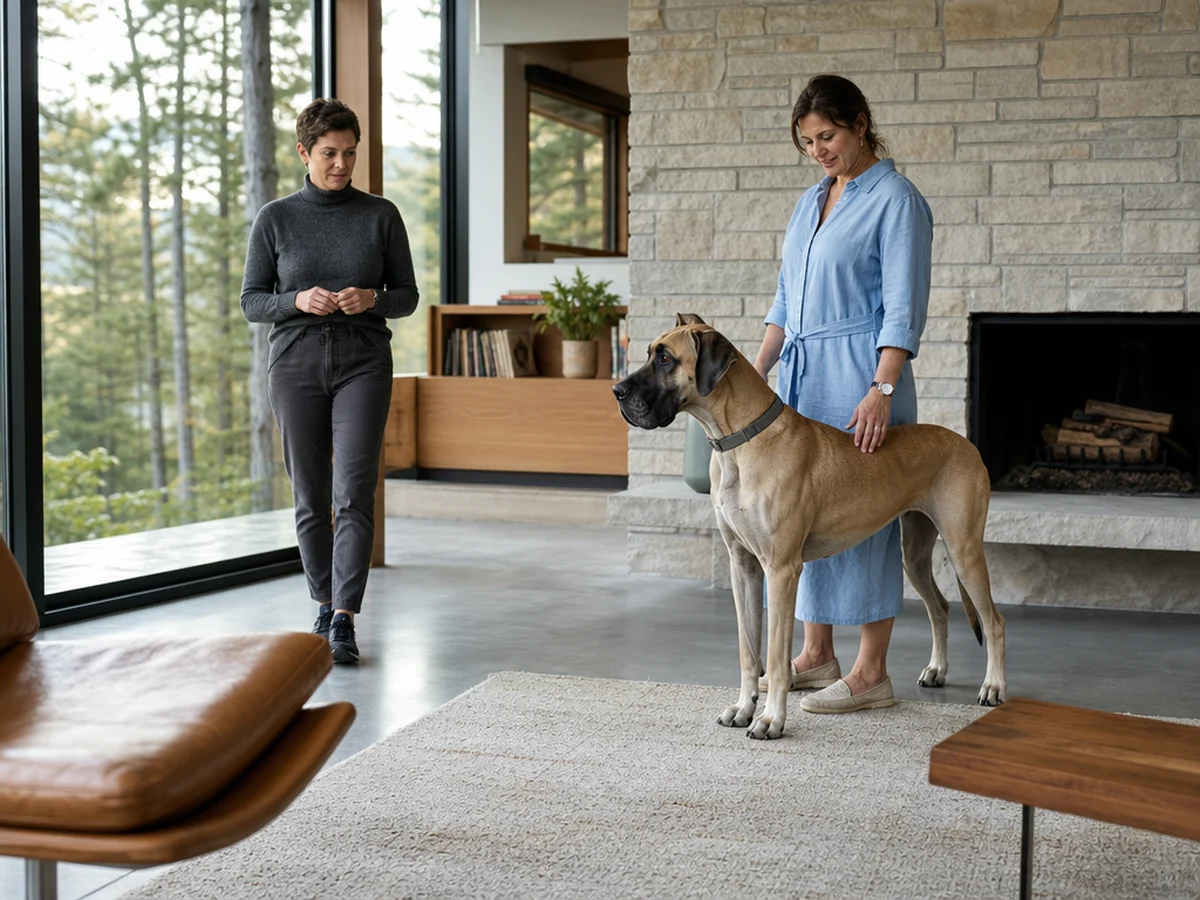
If the dog jumps, pulls hard or becomes frantic, the helper immediately steps away. Nobody speaks, reaches or pushes. When the dog returns to the floor, the handler marks and feeds low. The next approach begins from an easier distance instead of charging straight back to the point of failure.
Grounded Standing Counts
Do not require a sit unless it helps this individual remain comfortable. A standing Great Dane with a loose body and four grounded paws meets the safety criterion. A dog who slams into a sit, quivers and launches as the helper moves has not yet learned the access rule.
Keep the first session to three or four approaches. A brief pause behind the barrier between them makes the opening and closing of access easier to see. We want the person's movement to carry information, not become background activity while the dog rehearses pulling.
Add a release cue after the helper steps away. The handler can toss a reward behind the dog and move with them to the waiting area. This gives the approach a clear finish and prevents the Great Dane from hovering at the end of the leash while waiting to launch again.
Four Paws Down Replaces Jumping on People
Once the helper can approach, add one second of contact. The helper touches the shoulder or chest from the side, then removes the hand. The handler rewards on the floor while the paws remain grounded. Contact resumes only if the dog stays loose and voluntarily remains near the helper.
Humane World training guidance pairs prevention with reinforcement for an alternative. Here, the alternative is not a ceremonial sit. It is a safe approach followed by brief contact that the dog can leave. This makes greeting access valuable without trapping the dog beside a stranger.
| Gate | What Opens It | What Closes It |
|---|---|---|
| Approach | Loose leash and grounded paws | Jumping, hard pulling or fear |
| Contact | Loose body and voluntary proximity | Paws lifting, retreat or tension |
| Repeat greeting | Calm recovery after a pause | Escalating speed or grabbing |
Vary the reward. Sometimes food arrives from the handler, sometimes the helper steps closer and sometimes the dog gets permission to sniff and leave. If every repetition follows an identical food lure, the dog may watch the hand rather than understand that grounded behavior controls access.
Watch the whole body during contact. A closed mouth, weight leaning away, low tail or repeated head turn may mean the dog wants space even while the paws stay down. Close contact and let the dog leave. Grounded posture is a safety requirement, not proof that the greeting feels good.
Close Access After Jumping on People
The response to a jump should be predictable and physically safe. The helper folds hands close to the body, turns slightly and steps away. The handler moves backward to create space without yanking the leash. As soon as all paws return to the floor, mark, reward low and pause before deciding whether to try again.
Do not knee the chest, step on the feet or use painful equipment. AVSAB's humane training statement supports reward-based teaching and environmental management. Force can add fear or conflict to greetings while failing to show the dog how safe access works.
One jump does not require a long interruption or the end of every interaction. Look at recovery. If the dog can turn, eat and approach more slowly, offer one easier repetition. If jumping speeds up, grabbing begins or the dog stops responding, close the barrier and finish. Rest is more useful than repeating the same failure.
A sudden increase in jumping or sensitivity can accompany pain, stress or another physical change. Keep regular veterinary visits and ask your veterinarian about behavior that changes abruptly, especially when movement, appetite, sleep or comfort changes too.
Review the preceding ten seconds. The helper may have bent forward, contact may have lasted too long or the second greeting may have followed too quickly. Change that condition rather than making the handler's response louder. The gate system works because access changes immediately and calmly.
Household Rules for Great Dane Jumping on People
Inconsistent access keeps jumping profitable. One person may enjoy a hug from the dog while another cannot safely absorb it. Choose the rule for the most vulnerable person the Great Dane will meet: greeting access opens for four paws down, and nobody invites paws onto a body.
Give visitors a script before they arrive. “Stand sideways. Approach while paws stay down. Step away if they lift.” The handler runs the leash and rewards. A visitor who cannot follow that script stays behind the barrier and does not become a training helper.
The site's Great Dane settle guide can provide a waiting place after greetings. Teach the mat separately, then use it between short access turns. Do not ask a dog to hold a long settle while a beloved person repeatedly calls from across the room.
Keep the Human Script Short
Post the script near the entry and rehearse it once without the dog. Smooth human movement matters. A helper who freezes, waves arms or pushes may accidentally turn the closing gate into exciting play. Two remembered lines are more reliable than a lecture delivered while the dog is already jumping.
Decide who may run a rehearsal. Children and guests with limited balance should never hold the leash or operate the barrier. One adult handles the Dane, and another adult can coach the helper. Clear roles prevent several people from calling, feeding and moving at once.
Keep greetings optional for the dog too. Turning away should close contact without anyone following, coaxing or reaching across the retreat path.
Jumping on People in Three Real Settings
Transfer the access gates one setting at a time. Keep the helper familiar and the sequence short. New places add smells, movement and limited space, so begin farther away than the dog needed at home. Bring the same rewards and use the same marker.
At the Front Door
Have the helper enter while the dog remains behind a gate. After coats and bags are down, bring the dog out on leash. Practice one approach and one second of contact, then return behind the gate. Add the sound of the doorbell only after the entry itself is manageable.
On a Neighborhood Walk
Ask the person to stop several feet away. The dog does not have to greet. If the leash stays loose and the body remains comfortable, approach in a curve. End contact after one second and move on. Decline surprise greetings when there is no safe retreat route.
When Family Comes Home
The returning person enters behind a barrier, puts belongings away and waits for the dog to settle enough to eat. Then the handler opens one approach. This may take longer than a stranger rehearsal because familiar people often carry a strong history of excited contact.
Track the first gate that closed, not a vague good-or-bad score. The approach may have been too fast, contact too long or the repeat greeting unnecessary. That detail tells you what to simplify. It also keeps this plan distinct from broader Great Dane household manners.
Repeat a setting across several days before combining them. Success at the front door does not automatically transfer to a narrow sidewalk or an excited family reunion. The access rule stays the same, while distance, helper movement and recovery time return to easy levels.
Great Dane Jumping on People as Size Arrives
Increase realism while the dog is still successful. The helper can stand instead of sit, carry a bag or speak more naturally. Change one feature and preserve the access gates. A larger body does not need a harsher response. It needs earlier management and a rule that every person can apply before contact.
Measure progress in grounded approaches, comfortable one-second contacts and calm exits. The finished behavior is not a dog forced to sit under every reaching hand. It is a Great Dane who learns that four paws down open safe social access, jumping closes it and moving away is always available.
 Training basicsLoose-Leash Walking for a Great Dane Who Pulls
 BehaviorTeaching a Tall Great Dane Counter and Gate Boundaries
 Exercise and jobsGreat Dane Puppy Exercise: Balancing Play, Walks and Rest