 Great Dane
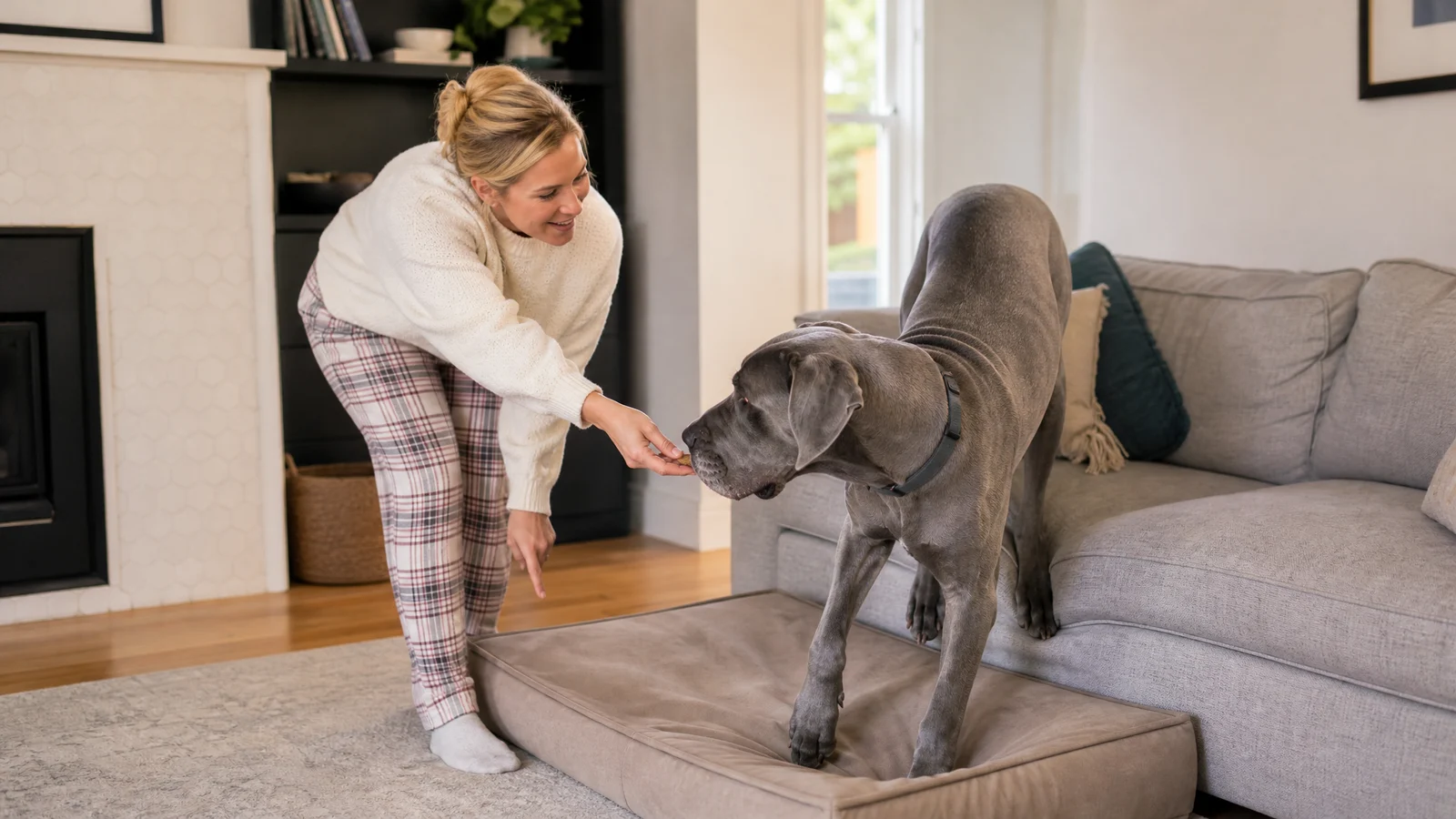
A Great Dane puppy should start learning Off and Settle in the first weeks at home, well before they reach 100 pounds. Most couch habits are set long before adolescence ends. Timing is the real question for this breed, because the wish to be on the couch never fades while the body attached to it grows to 110–175 pounds.
Danes are described in the breed standard as dogs who would rather spend their time lounging on the couch near a loved one than do almost anything else. Handled kindly, that gives you a dog who joins you on invitation, settles on a bed of their own and never crowds you. Handled by drift, it gives you a heavy adult who is hard to move.
Read on for the myths about outgrowing couch habits, invitations, Off, settle versus stay, personal space and furniture setups, then the questions owners ask next.
A Great Dane Puppy Won't Outgrow Couch Training
The belief goes like this: a small puppy on the sofa is harmless, and by the time size matters they will have worked out the rules. Dogs do not work things out that way. A habit that earns a warm spot beside you gets repeated, and a Dane has more reason than most to repeat it.
Many owners describe couch and bed sharing arriving by drift rather than decision. Puppy eyes win one night, then the dog has priority seating, then priority bedtime. Some find this very hard to undo. Nobody chose the arrangement, which is exactly why it sticks.
What Changes by Adolescence
The wish for the couch stays the same, but everything around it grows. A teenage Dane who has practiced climbing up for months is heavier and faster, with a long record of getting what they want.
At adult weight, a cute habit becomes a safety issue for guests, children and your own knees. Overwhelmed excitement can lead to jumping that bruises.
The Order to Teach Things
The breed club names a desire to please as the Dane's main asset in training and strongly recommends kindergarten puppy classes for puppies three to six months old. Use that window well.
Teach the invitation word and the Off cue first, in the first weeks, then add a settle on a bed beside the couch. Practice both in every room where the family sits, so the dog learns that the rules travel with them. Finally, repeat the whole set with each family member and then with visitors, so the cues mean the same thing no matter who is on the couch.
Letting a Great Dane Up Does Not Spoil Training
The opposite myth says one invitation teaches the dog that the whole couch belongs to them. It does not, as long as the invitation is clear. Dogs learn quickly that the couch is open when asked and closed otherwise, and that distinction is easier for them than a blanket rule with exceptions nobody explains.
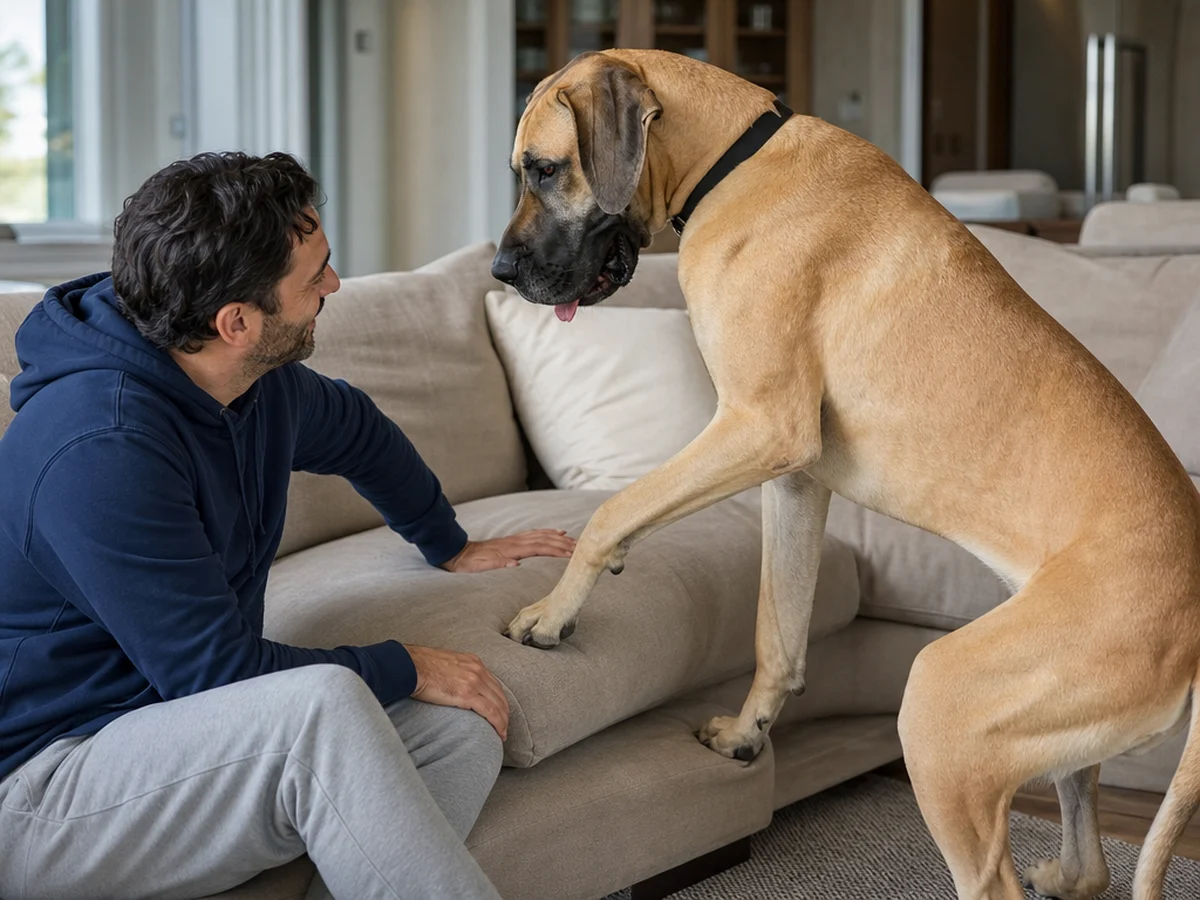
Owners who allow bed access only on permission, and who teach no jumping or begging, keep the closeness their Dane craves and still keep boundaries. The breed is easily trained but needs consistency, so every person in the house must use the same signals.
Here is the sequence for invited-only access:
- Choose one invitation word, such as "Up," and one exit word, such as "Off." Write them where the whole family can see them.
- Stand next to the couch with treats in hand while the dog stands or sits on the floor. Say "Up" cheerfully and pat the cushion.
- When the dog sinks onto the cushion and their body relaxes, say your chosen marker word and give a treat straight away.
- Cue "Off," step back, and reward on the floor.
- Between invitations, reward the dog for standing by the couch and not climbing.
- If the dog jumps up uninvited, calmly stand, walk away from the couch for a minute, and start the sequence again.
- Fade the cushion pat until the word alone works.
The lesson the dog absorbs is simple. Waiting earns the couch, and climbing uninvited earns a boring minute.
How Does Reward-Based Great Dane Training Teach Off?
Danes are sociable and eager to please, and reward-based training succeeds because a dog repeats whatever earned them something they love, whether that is food, a toy or praise. That is all Off needs.
Decide the final behavior first: the dog steps down on cue and waits on the floor for a reward. Then build it in small clicked steps.
- With the dog on the couch by invitation, hold a treat at their nose and lure toward the floor.
- Mark the instant the front paws touch down, then give the treat low so they do not have to lunge.
- When they follow the lure smoothly, say "Off" just before your hand moves.
- Shrink the lure into a plain hand signal, then into the word alone.
- Practice at different times of day, with different people and with different cushions.
If the dog ignores the cue, do not repeat it louder. Stand up, end the couch time calmly, and try again later with a better treat and an easier setting.
Ask for a controlled step down rather than a leap. Landing from a high seat is hard on a heavy body, so a low step or ramp helps a growing puppy. Keep up regular vet visits as your Dane grows, and ask whether your dog's jumping habits suit their stage of growth.
Settle Training Is Not the Same as Stay
Owners often use these words as if they meant the same thing, and the confusion causes frustration. A stay asks the dog to hold one position until released. A settle asks them to relax in a spot, free to shift, sigh and doze for as long as you like.
Settle suits a Dane better for everyday life. These dogs want to be near you, often within a couple of feet while the family watches TV or eats, and holding a rigid position beside the dinner table is an unfair ask. A relaxed spot nearby works with that instinct instead of against it.
Teaching Settle on a Mat or Bed
- Put the mat or bed where the family actually spends time, such as near the TV or the table.
- Let the dog explore it. When they choose to lie down there, mark and reward in place.
- Keep rewarding the calm parts too: slow breathing, a dropped head, a relaxed hip.
- Add your word, such as "Settle," once lying down comes readily.
- Lengthen the time gradually and add a chew or lick mat to make it pleasant.
- Release with a cheerful word, so the dog learns that settle has a clear start and finish.
Signs the Settle Is Working
You will know the settle is working when the dog heads to the bed on their own as the family sits down for TV or dinner. They lie on one hip with a loose body rather than perching alert, and they often curl into a smaller shape than you expect. Many owners are surprised how small a Dane curls up on a bed that looks too small. The clearest sign of all is that they stay on the bed through ordinary household movement without repeated cues.
Can Personal Space Training Work With a Cuddly Great Dane?
Danes rate 5 of 5 for affection with family, and they show it with their whole bodies. They lean, sit on people, follow you from room to room and rest their heads on your shoulder or the car console. Many return again and again for contact, even after being moved away. Teaching personal space does not mean teaching them to love you less. It means teaching when and how the contact happens.
Give Contact an Invitation Too
Use the same logic as the couch. Pick a cue, such as "Lean in," and reward the dog for coming to you when invited. A Dane who is welcomed at the right moments is much easier to ask for room at the wrong ones.
When you need space, send the dog to the settle bed and reward them there. Redirecting to a better spot works far better than pushing away or repeating "no," because it gives the dog something to do with their wish to stay close.
Teach a Calm Greeting
Quick movements and high-pitched squealing excite a puppy or dog, so keep arrivals low and quiet. Give your attention only once the dog is standing calmly, and cue Settle if the excitement builds.
Be careful what you reward by accident. Owners report that behaviors they encouraged became habits to manage, such as a paw that flies up when the dog is excited, or licking condensation off cups. Children need a rule too. Danes suit older children and teenagers better because of their great size, and young children should never be left unattended with a puppy or dog.
Training Beats a Great Dane Couch Ban
The usual advice for a giant dog is to ban the furniture outright. We disagree for most households. A blanket ban fights the breed's strongest wish, while a good alternative redirects it. Owners adapt their homes to a Dane in many ways, such as covering furniture with blankets, giving over a spare room or fitting a crate into the space they have.
Build the setup in layers:
- Cover the couch with blankets or washable, waterproof covers, and add a separate waterproof liner underneath, because a cover alone may not stop a spill.
- Give the dog a large bed of their own that is padded and easy to clean. Many owners use crib mattresses or child mattresses, which fit well, cost little and launder easily, especially with a vinyl cover and crib sheets.
- Choose orthopedic beds sized to the dog, or to the crate if you use one. Owners describe them as well padded and well liked.
- Make room physically. Owners give over a spare room or fit a crate into a medium apartment.
- Plan for mess. Mats and towels handle the water trails and dropped kibble that come with a big mouth, and a slow-feeder helps with food but not with water.
Make the dog's own spot the most comfortable place in the room, and the couch becomes an invited bonus rather than a daily fight.
What Great Dane Owners Ask Next About Training
A Dane wants to be close to the people they love, and the kindest training works with that wish. Teach Off, Settle and an invitation early, give them a bed that beats the floor, and every no comes paired with a clear yes. That clarity keeps the closeness comfortable for both of you, long after the puppy has become the largest member of the household.
Once couch manners are settled, owners usually move on to these questions.
Many owners next want to know which crate fits an adult and how to make it a place the dog loves, which we cover in choosing an XXL crate. Others wonder why a sweet dog sometimes acts like a watchdog and how to keep that polite, which is the subject of keeping watchdog habits polite. The third question is how to prepare a puppy for children, strangers and other dogs before adult size arrives, and you will find that in socializing a Great Dane puppy.
 Exercise and jobsGreat Dane Sports and Jobs Chosen by Motivation
 Exercise and jobsGreat Dane Exercise and Brain Games for Calm Days
 Training basicsThe Complete Reward-Based Great Dane Training Guide